
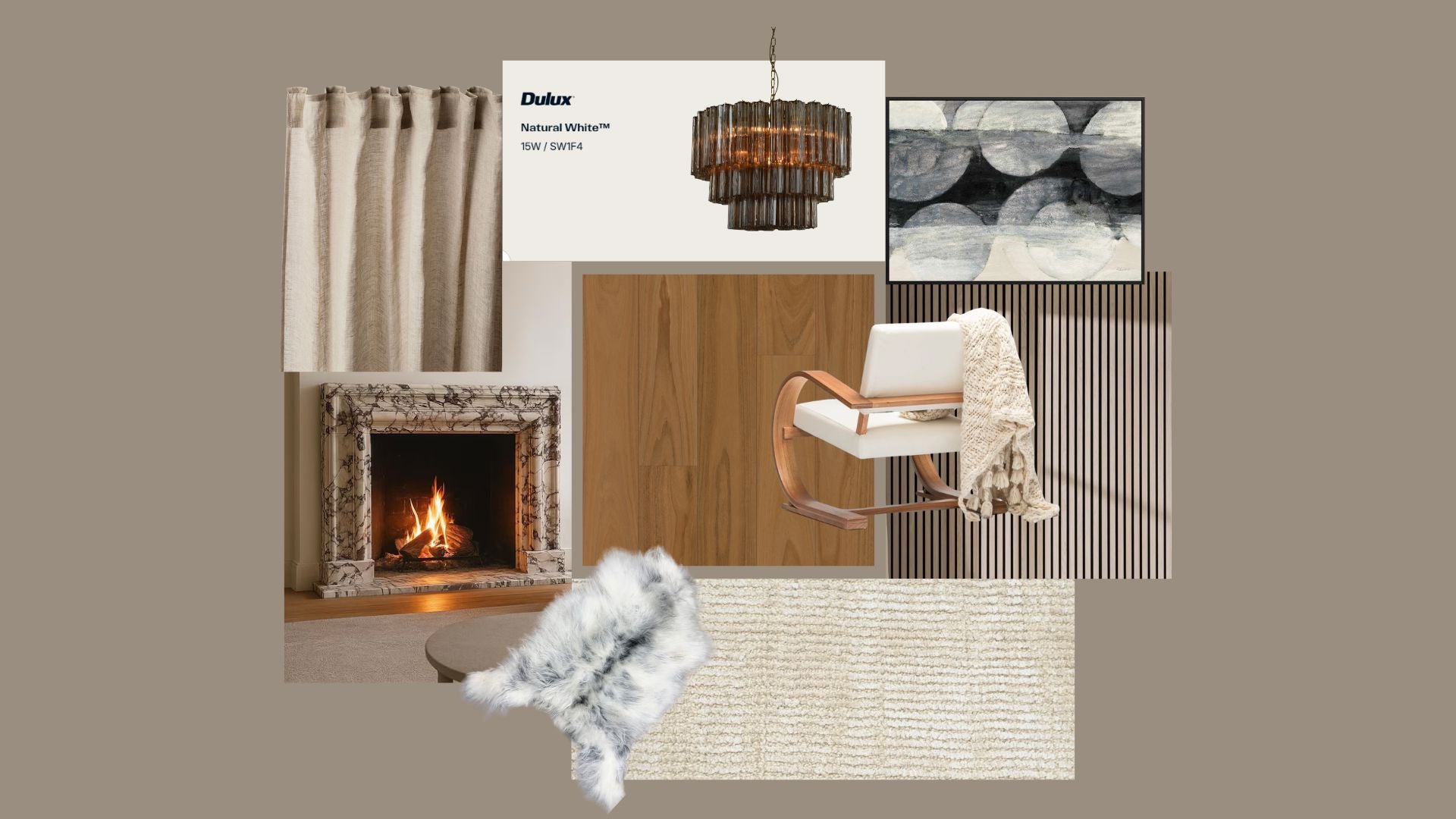

70/20/10 Texture Rule That Makes a Room Feel Right
Whether you are adding to a room or starting blank, after thinking about the colours I like to think of textures. You know the feeling. You walk into a space and something just works. The room is calm but not flat. Interesting but not busy. Everything feels like it belongs.
We all tend to gravitate towards a colour when we decorate our space. I am not sure about you but it makes me feel indecisive about decorating a space. I like to use texture to add to our current collection of furniture, decorating and lighting. For this purpose I used a simple muted pallet in the collage above.
Most people attribute that feeling to good taste. And while taste plays its part, there is usually something more structural underneath it, a quiet logic or rule that the eye registers before the brain does.
Sometimes it is as simple as thinking, “I need to add a rattan weaved planter, animal hide or a textured painting”.
One of the useful texture rule is the 70/20/10 texture rule. This rule makes you understand how some interior designers can make a room look right, even with that one “ugly” texture sculpture.
What is the 70-20-10 texture rule?
The principle is simple. In any well composed room, texture should be distributed in roughly three layers:
70% dominant texture : the primary surface that sets the room's tactile tone. This is usually your largest element: a smooth plaster wall, a timber floor, a linen sofa. It doesn't demand attention. It simply is, everywhere, underfoot and overhead and in your peripheral vision. Its job is to create a consistent ground — the thing that makes everything else readable.
20% secondary texture : the layer that adds interest without disrupting the calm. A woven rug on a timber floor. A boucle cushion on a smooth sofa. A rattan woven chair against a plastered wall. This is where the room begins to breathe, where the eye finds something to travel toward, where the space moves from resolved to alive.
10% accent texture : the detail that makes the room memorable. A rough ceramic vessel. A braided fringe on a throw. The chain on a pendant light. The faceted surface of a cabinet door. These are the moments people photograph, the things guests reach out to touch without quite knowing why. They are small in proportion and enormous in effect.
Why It Works
Texture is the sense we process before we consciously register it. Before you know what you're looking at, your nervous system has already decided how a room makes you feel and texture is one of the primary signals it reads.
Too much of the same texture and a room feels flat, resolved to the point of lifelessness. Too many competing textures and it becomes exhausting the visual equivalent of too many people talking at once. The 70/20/10 ratio works because it gives the eye a clear hierarchy to move through: rest in the dominant, travel to the secondary, pause at the accent.
It is, in the end, the same logic that makes a good sentence work. A dominant plain, punctuated by something specific.

In Practice
The rule is a guide, not a grid. You don't need a measuring tape, you need an honest eye.
Stand in your room and ask: what is the texture I feel most, everywhere, all the time? That is your 70. Does it feel like enough of a foundation, or is it fighting for attention with everything else? Then find your 20, the supporting layer that adds warmth or contrast or depth without becoming another dominant. And finally, look for your 10. The thing that shouldn't work but does. The unexpected material, the tactile surprise, the detail that makes someone say “where did you find that?” I love when designers incorporate that odd sculpture or chandelier that just works.
You might identify all three layers, or maybe you don’t and may need to add that secondary texture or finally find the excuse to buy that accent texture you cannot stop thinking about.
If you can't find the 10, add something. If everything feels like the 70, add texture in layers. If nothing feels like the 70, edit or move things around until something takes the lead.
The Quietest Design Rule Is Often the Most Powerful
The 70/20/10 rule will never be the most talked-about principle in interior design. It doesn't produce a single hero moment or a shareable before-and-after. What it produces is room that feels right without anyone being able to say exactly why. It makes a room feel personalised and step away from standard ways of decorating.
And that, ultimately, is the goal.
How to clean outdoor furniture?